Apple's M5 Chip Arrives: A Deep Dive into the Performance Gains Over M4
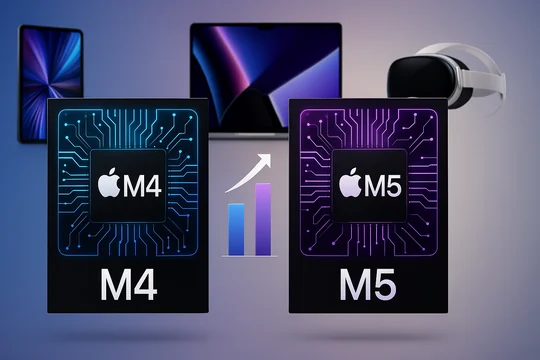
Apple is set to shake up its product lineup this October 2025 with the introduction of the M5 chip, marking another step forward in the company's silicon revolution. Expected to debut in the iPad Pro, Vision Pro headset, and entry-level 14-inch MacBook Pro, the M5 represents an incremental but meaningful upgrade over last year's M4 chip.
Performance Leaps That Matter
Early benchmarks paint an impressive picture of the M5's capabilities. Users can expect approximately 10% faster single-core performance and a more substantial 15-20% boost in multi-core operations compared to the M4. However, the real star of the show is the GPU performance, with leaked benchmarks suggesting up to 36% faster graphics processing—a significant jump that will delight creative professionals and power users alike.
Built on TSMC's refined third-generation 3nm process, the M5 doesn't just bring raw power—it delivers improved power efficiency, promising longer battery life without compromising performance.
Who Should Upgrade?
The upgrade calculus depends largely on your current hardware. For users still running M1 or M2-powered devices, the M5 represents a compelling leap forward. The accumulated improvements across two or three generations make this a worthwhile investment.
However, if you purchased an M4 device in 2024, the decision becomes more nuanced. While the M5's improvements are real, they're evolutionary rather than revolutionary. Unless you're pushing your current device to its limits daily, waiting for the M6 or future iterations might be the smarter financial choice.
The Product Lineup
Apple's initial M5 rollout focuses on three key products:
iPad Pro: Already spotted in early unboxing videos, the M5 iPad Pro promises to be the most powerful tablet on the market, ideal for professional creative work and intensive multitasking.
Vision Pro: The spatial computing headset receives a crucial performance upgrade, potentially addressing some of the processing concerns from the first generation.
MacBook Pro (14-inch, entry-level): The base model MacBook Pro gets refreshed, though professionals waiting for M5 Pro and M5 Max variants in larger MacBooks will need to wait until early 2026.
The Bigger Picture
The M5's arrival continues Apple's aggressive silicon roadmap. What began with the groundbreaking M1 in 2020 has evolved into a comprehensive family of chips that have fundamentally changed expectations for laptop and tablet performance.
With inventory shortages already being reported for current M4 base model MacBooks, the signs point to an imminent refresh. For those in the market for a new Apple device, waiting just a few more weeks could mean the difference between yesterday's technology and tomorrow's performance.
As Apple continues to refine its silicon architecture, one thing becomes clear: the gap between mobile and desktop computing continues to narrow, and the M5 is another step toward a future where power and efficiency aren't competing priorities—they're complementary strengths.