Apple's Emergency SOS via Satellite Saved 6 Avalanche Survivors Near Lake Tahoe
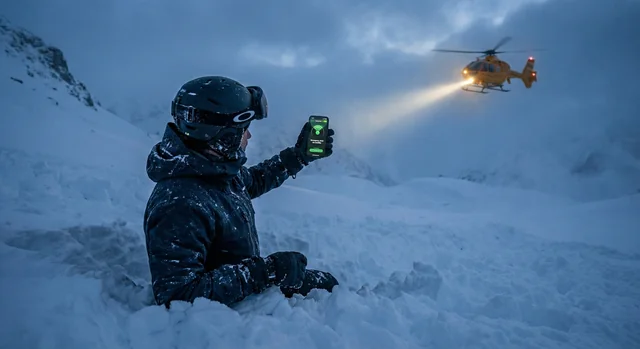
When six skiers were buried by an avalanche near Lake Tahoe on February 18, 2026, they had no cell service, no Wi-Fi, and no conventional way to call for help. What they did have was an iPhone — and that turned out to be enough. Apple's Emergency SOS via Satellite feature kept the group in contact with rescue teams for over four hours, ultimately saving all six lives.
What Happened Near Lake Tahoe
The six survivors of Tuesday's avalanche communicated with emergency responders using the Emergency SOS feature on the iPhone and an emergency beacon, confirmed Don O'Keefe, the law enforcement chief for California's Office of Emergency Services. The feature allowed the group to stay in touch with the Nevada County Sheriff's Office, which was coordinating the rescue efforts in real time.
"One of my personnel was communicating with one of the guides over a four-hour period, giving information back to the Nevada sheriff's office and coordinating what rescues could be permitted," O'Keefe said.
That four-hour window of communication — in a remote alpine zone with zero cellular coverage — is exactly the scenario Apple designed Emergency SOS via Satellite for.
How Emergency SOS via Satellite Works
Apple instructs users to try calling an emergency number like 911 first. If that call doesn't connect due to lack of signal, the iPhone automatically offers the option to send a text message to emergency services via satellite. Here's what happens next:
- The phone connects to an overhead satellite — the user must be outside with a clear view of the sky and horizon.
- The text is relayed to a network of emergency responders who ask for your location, the nature of the emergency, emergency contacts, and remaining battery life.
- Responders then coordinate with local authorities to dispatch help.
The feature is deliberately stripped-down — satellite bandwidth is limited, so it handles short, critical messages rather than full conversations. But as the Lake Tahoe incident proves, that is more than enough to save lives.
Which iPhones Have Emergency SOS via Satellite
The feature is available on all models of the iPhone 14, 15, 16, and 17. In the United States, the phone must be running iOS 16.1 or newer. Crucially, Emergency SOS via Satellite is free for two years after an iPhone is activated — after that, Apple has not yet announced long-term pricing details.
A similar satellite messaging feature also allows iPhone users to text friends and family (not just emergency services) when they have no cellular or Wi-Fi connection, useful in remote hiking, camping, or travel scenarios.
Android Users Have It Too
Apple isn't alone in this space. Android users with Google Pixel 9 (some versions) and all versions of the Pixel 10 can also text emergency services via satellite. The technology is gradually becoming a standard safety feature across premium smartphones rather than a niche add-on.
Why This Matters Beyond the Headlines
The Lake Tahoe rescue is the latest in a growing list of real-world rescues attributed to satellite-connected smartphones. Previous incidents include hurricane survivors using the feature during Milton in 2024 and hikers rescued in remote national parks. Each incident adds to the evidence that satellite connectivity is no longer a luxury feature — it's a life-safety standard.
For years, satellite communicators meant bulky, expensive dedicated devices like Garmin inReach or SPOT trackers. The integration of this capability directly into a mainstream consumer smartphone changes the calculus entirely. Most people hiking, skiing, or travelling in remote areas already carry an iPhone. They don't need additional gear — the safety net is already in their pocket.
"Apple's Emergency SOS via satellite just proved its worth. Avalanche near Tahoe. 6 survivors. No cell signal. 4 hours of satellite comms coordinating their rescue. iPhone 14+ with iOS 16.1 has this built in, free. It might save your life too."
How to Check If Your iPhone Has Emergency SOS via Satellite
- Go to Settings → Emergency SOS.
- Look for the "Call via Satellite" option — if your device and region support it, it will appear here.
- Make sure you are running iOS 16.1 or later (Settings → General → Software Update).
- The feature works in the US, Canada, the UK, Europe, Australia, and several other regions.
You don't need to set anything up in advance — when a regular call or text fails in an emergency, your iPhone will automatically prompt you to try via satellite.
The Bottom Line
Six people are alive today because a feature most iPhone users have never needed — and many don't even know exists — worked exactly as intended when everything else failed. As satellite connectivity continues to roll out across more devices and regions, the question isn't whether this technology saves lives. The Lake Tahoe avalanche rescue has answered that definitively. The question now is whether every smartphone maker treats it as a baseline safety requirement going forward.