Apple Is Building Three AI Wearables Including an AirTag-Sized Camera Pendant
Apple's AI Wearable Ambitions Go Beyond the Vision Pro
Apple is reportedly developing not one, but three distinct AI-powered wearable devices, according to a detailed report from TechCrunch citing sources familiar with the company's plans. The devices represent Apple's broadest push yet into AI hardware — and they're nothing like the Vision Pro.
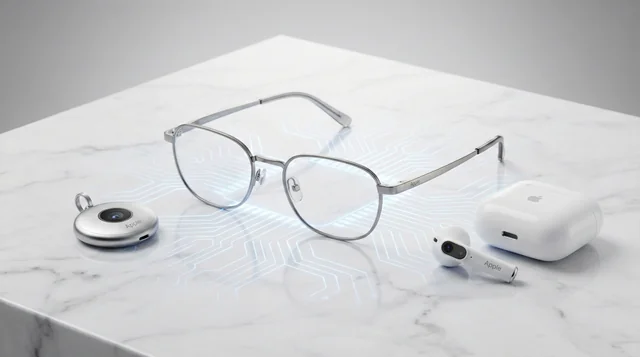
The three wearables in development include an AirTag-sized AI pendant with a camera that clips to clothing, a pair of smart glasses with integrated AI capabilities, and a home-focused AI device that could serve as Apple's answer to the smart home hub. Each targets a different use case, but all share one thing in common: they're designed to make AI invisible and ambient.
The AI Camera Pendant: Apple's Most Radical Idea
The most eye-catching device in the lineup is the AI camera pendant — a small, clip-on device roughly the size of an AirTag that features a built-in camera and microphone. Think of it as Apple's take on the Humane AI Pin, but with Apple's characteristic focus on miniaturization and design.
According to reports, the pendant would:
- Capture visual context from your environment throughout the day
- Process information on-device using Apple's neural engine
- Integrate with Siri and Apple Intelligence for contextual assistance
- Prioritize privacy with on-device processing and no always-on recording
The device would essentially give Siri "eyes," allowing Apple's AI assistant to understand your physical environment — what you're looking at, who you're talking to, and what's happening around you — without requiring you to pull out your phone or wear a headset.
Smart Glasses: Taking on Meta's Ray-Ban Partnership
Apple's second AI wearable is a pair of smart glasses, positioning the company in direct competition with Meta's successful Ray-Ban Meta glasses. Unlike the Vision Pro, these would be designed to look and feel like regular glasses.
The smart glasses are expected to feature:
- Lightweight design indistinguishable from regular eyewear
- AI-powered visual search and real-time translation
- Audio capabilities with spatial audio speakers built into the arms
- Camera integration for first-person photo and video capture
- Apple Intelligence integration for hands-free AI interactions
This is a notable strategic shift for Apple. While the Vision Pro targeted immersive computing at $3,499, smart glasses represent the opposite approach: minimal, ambient, and affordable.
Home AI Device: Apple's Smart Home Brain
The third device is described as a home-focused AI hub, potentially combining elements of HomePod, Apple TV, and iPad into a single AI-powered home command center. While details are more limited, sources suggest it could feature a display, camera, and serve as the central intelligence node for HomeKit and Apple's broader smart home ecosystem.
Why Three Devices? Apple's AI Hardware Strategy
Apple's multi-device approach reveals a clear strategic vision: AI shouldn't be confined to a single form factor. Instead, it should be available in whatever device makes sense for the context:
- On the go: The camera pendant captures context without screen time
- Out and about: Smart glasses provide visual AI without reaching for your phone
- At home: The home device anchors your AI experience in your living space
This strategy stands in contrast to companies like Humane and Rabbit, which bet everything on a single AI hardware form factor — and struggled. Apple is hedging its bets by exploring multiple approaches simultaneously.
The AI Hardware Wars Heat Up
Apple's entry into AI wearables intensifies an already competitive landscape. Meta has found unexpected success with its Ray-Ban smart glasses. Google is reportedly working on new AI-powered glasses. Samsung has its Galaxy Ring and is rumored to be developing AI earbuds. And startups like Humane, Rabbit, and Limitless continue to explore novel AI hardware form factors.
The key question isn't which device will win — it's which form factor consumers will actually adopt. The history of wearable tech suggests that the winning device will be the one people forget they're wearing.
The Bottom Line
Apple's trio of AI wearables signals that the company sees AI hardware as the next major platform shift — one that goes far beyond the iPhone. The AirTag-sized camera pendant, smart glasses, and home AI hub represent Apple's vision for a future where artificial intelligence is woven into every aspect of daily life, delivered through devices so small and natural that they disappear into the background. The form factor that ultimately wins this race will define the next era of personal computing.