Apple Is Testing Four Smart Glasses Frame Designs Ahead of 2027 Launch
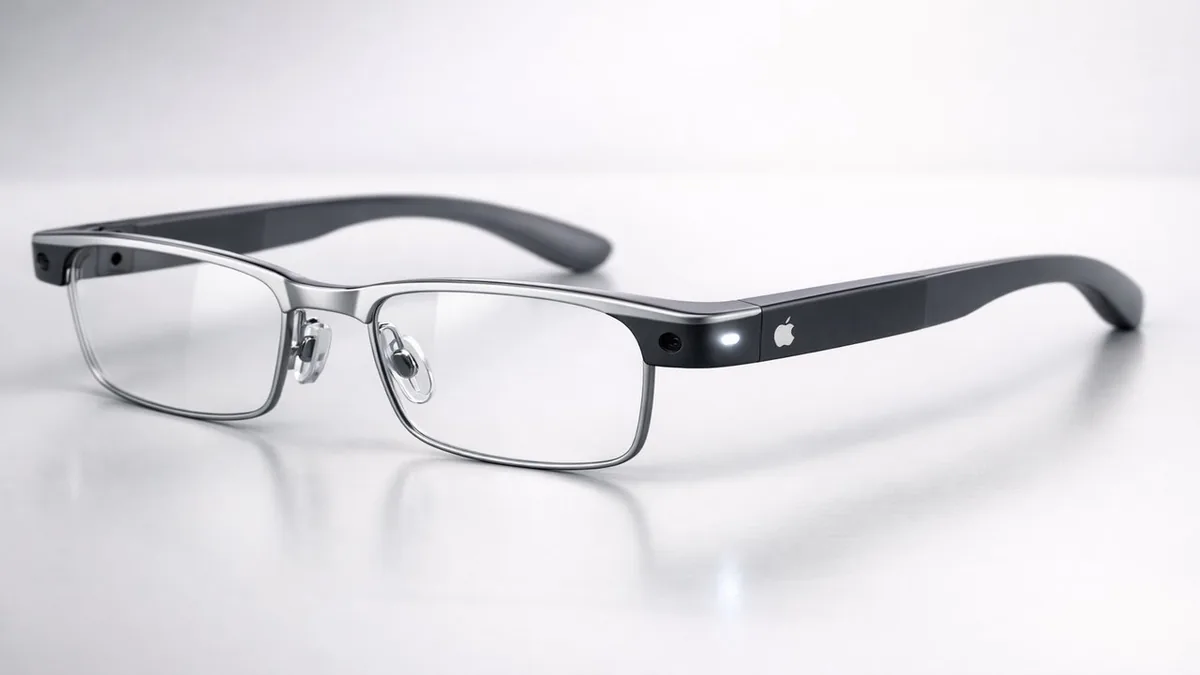
Apple is testing four distinct smart glasses frame designs featuring vertically-oriented oval cameras, Bloomberg reported, as the company accelerates development of AI-powered wearables targeting a 2027 launch. The glasses will ship without a built-in display — a deliberate departure from augmented reality headsets — betting instead on voice-controlled AI interaction through an enhanced Siri. If production begins on schedule in December 2026, Apple would enter the smart glasses market as Meta Ray-Ban continues to dominate with over 60% market share, setting up the most consequential wearable rivalry since AirPods challenged the headphone industry.
What Apple's Smart Glasses Are Designed to Do
Unlike the Vision Pro, Apple's smart glasses are designed as lightweight everyday wearables — targeting under 50 grams — with no visual display. The glasses use a dual-camera system: one high-resolution unit for photos and video, and a second integrating LiDAR for environmental mapping and object recognition. These feed Apple's Visual Intelligence system, enabling real-time landmark identification, text reading, plant recognition, and distance measurement through an enhanced Siri voice interface.
The frames are built in-house using premium materials including titanium and aluminum, with cameras and sensors hidden behind smoked glass or integrated into hinges to avoid the "glasshole" aesthetic that doomed Google Glass. Prescription insert compatibility is expected, similar to Vision Pro's Zeiss partnership model. A custom AI processor built on Apple Watch S-Series DNA handles on-device inference at low power consumption.
Why Apple Is Skipping the Display
Apple's decision to ship glasses without a display is the most strategically interesting detail in Bloomberg's reporting. It signals that Apple believes voice-plus-AI context awareness — rather than visual AR overlays — is the right product for everyday wear. The Vision Pro proved that immersive visual displays work in controlled settings; Apple appears to be betting that glasses worn all day need to be socially acceptable and battery-efficient first, with intelligence delivered through audio rather than optics.
This positions Apple's glasses directly against Meta Ray-Ban, which also uses cameras and audio without AR displays. The competition will be fought on ecosystem integration (iPhone, iCloud, Continuity), AI capability, and camera quality — areas where Apple has structural advantages over Meta's hardware division. The timing also coincides with iOS 27, expected to feature significantly upgraded Siri AI capabilities that the glasses would rely on.
Frequently Asked Questions
When will Apple Smart Glasses launch?
Bloomberg reports production is targeting December 2026, with a public launch in 2027. No official announcement has been made by Apple.
Will Apple Smart Glasses have augmented reality?
No. Apple's smart glasses are designed without a built-in display. They use cameras, LiDAR, and Siri voice interaction rather than visual AR overlays — making them a lightweight everyday wearable rather than an AR headset.
How do Apple's glasses compare to Meta Ray-Ban?
Both use cameras and audio-based AI without AR displays. Apple's differentiators are expected to be ecosystem integration with iPhone and iCloud, higher-end camera quality, on-device AI processing, and Siri — versus Meta's social sharing focus and established distribution through Ray-Ban.
The Bottom Line
Apple testing four frame designs is the clearest signal yet that smart glasses are a serious product category, not a concept. By going display-free and betting on AI-first voice interaction, Apple is validating the same product thesis as Meta Ray-Ban while bringing its ecosystem and hardware advantages to bear. A 2027 launch would give Apple time to iterate while Meta refines its market — but it also means Meta has another full year to entrench before Apple arrives. The glasses race is now officially on.