Andy Jassy's 2025 Letter to Shareholders: AI Is Moving 10x Faster Than Electricity Adoption
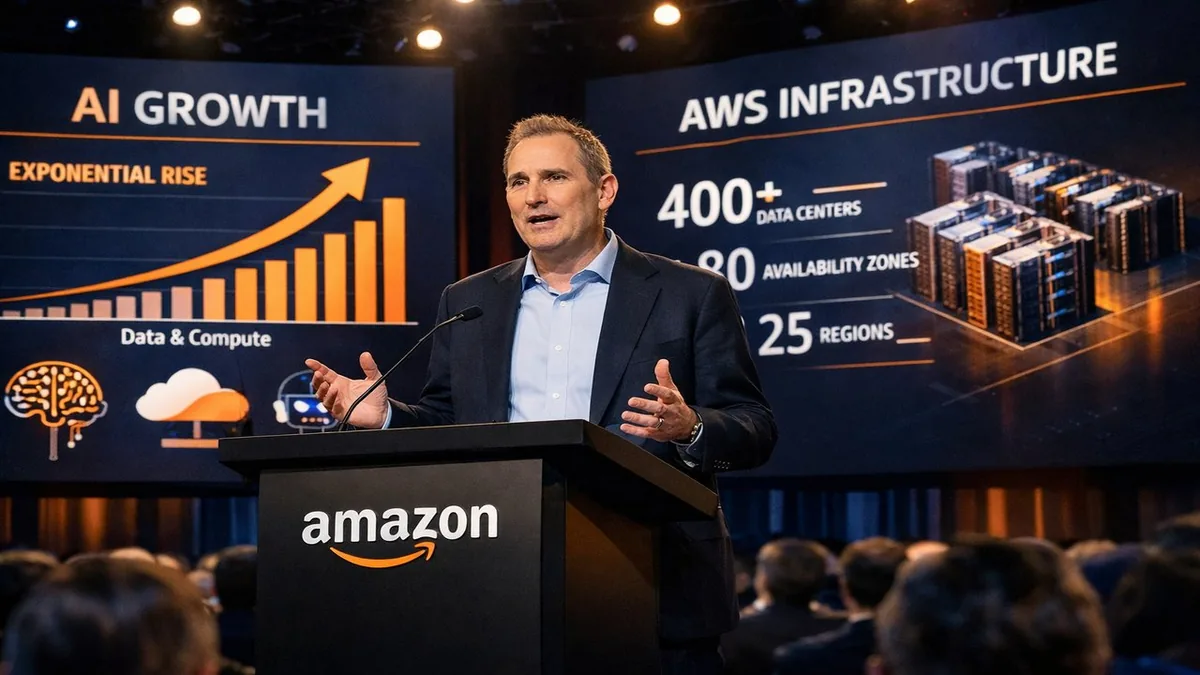
Amazon CEO Andy Jassy published his 2025 annual letter to shareholders on April 9, laying out a sweeping vision for why artificial intelligence represents a generational inflection point for both Amazon and the broader technology industry. The letter, framed around the idea that meaningful progress is rarely linear, positions AI as moving roughly 10 times faster than electricity adoption — and argues that Amazon's bets on AI infrastructure are not speculative spending but predictable investments backed by customer commitments. This builds on the accelerating enterprise AI adoption visible across the industry in early 2026.
The Six Truths About AI That Jassy Laid Out
Jassy's letter centers on six observations about AI's trajectory. First, adoption speed is unprecedented — ChatGPT reached 100 million users in two months, roughly 4x faster than TikTok and 15x faster than Instagram, with OpenAI and Anthropic now approaching $30 billion revenue run rates. Second, AWS's AI revenue is scaling faster than AWS itself did in its early years: three years into the AI wave, AWS's AI revenue run rate exceeds $15 billion — nearly 260 times larger at the comparable point in cloud's history.
Third, capacity constraints are still limiting growth, not demand. AWS added 3.9 gigawatts of power capacity in 2025 and plans to double total capacity by end of 2027, yet still has unserved customer demand. Fourth, Amazon's custom chips are outperforming off-the-shelf alternatives — Graviton offers up to 40% better price-performance than x86 and is used by 98% of the top 1,000 EC2 customers, while Trainium3 ships now at 30-40% better performance than Trainium2, which itself was nearly sold out.
Amazon's $200 Billion Capex Bet on AI
The most striking number in the letter is the planned 2026 capital expenditure of approximately $200 billion — a figure Jassy contextualizes as disciplined rather than reckless. Customer commitments, including OpenAI's $100 billion-plus reservation, make the spending predictable. The assets being built have 5-6 year useful lives, and Jassy argues the medium and long-term free cash flow return will substantially exceed the short-term outlay.
Amazon's chips business alone has reached a $20 billion annual run rate with triple-digit year-over-year growth — Jassy noted that if it were a standalone company, the chips segment would run at roughly a $50 billion annual rate. The financial services sector's rapid AI adoption is one major driver of that demand, as banks and institutions race to integrate AI into core workflows.
Beyond AWS: AI Reshaping Amazon's Core Businesses
Jassy's letter goes beyond cloud infrastructure. Alexa has been completely rebuilt with AI — users are talking to it twice as frequently, buying three times as many devices, and engaging 50% more with smart home features. Amazon's grocery business, now the second-largest US grocer at $150 billion in gross sales, saw same-day fresh perishables delivery grow 40x since early 2025.
Amazon now operates over one million robots in its fulfillment centers and is committing $4 billion to expand same-day delivery to rural communities. Amazon's Leo satellite broadband, with over 200 satellites launched, has signed Delta Airlines to equip 500 planes starting 2028 — offering 6-8 times better uplink than competing solutions.
Frequently Asked Questions
What did Andy Jassy say about AI in his 2025 shareholder letter?
Jassy framed AI as moving 10x faster than electricity adoption and outlined six truths about AI's rise, including AWS's $15B+ quarterly AI revenue run rate, Amazon's $200B 2026 capex plan, and the outperformance of Amazon's custom Trainium and Graviton chips against competitors.
What is Amazon's AWS AI revenue run rate in 2026?
AWS AI revenue exceeded a $15 billion quarterly run rate as of Q1 2026, growing nearly 260 times faster at a comparable stage of development than AWS cloud itself grew in its early years — a figure Jassy highlighted as evidence of AI's unprecedented adoption speed.
How much is Amazon spending on AI infrastructure in 2026?
Amazon plans approximately $200 billion in capital expenditure in 2026, primarily for AI and cloud infrastructure. Jassy describes the investment as predictable given customer commitments — including OpenAI's $100 billion-plus reservation — and argues it will generate substantial long-term free cash flow returns.
The Bottom Line
Jassy's 2025 letter is less a CEO update and more a manifesto for why Amazon is betting its balance sheet on AI. The $200 billion capex, the triple-digit growth in chips, and the 260x faster AWS AI ramp versus historical cloud growth all point to a company convinced this is the defining technology moment of the decade — and determined not to be supply-constrained when the market catches up.