Alibaba Cloud Bundles Top Chinese AI Models Into One Cheap Subscription — But Can It Compete?
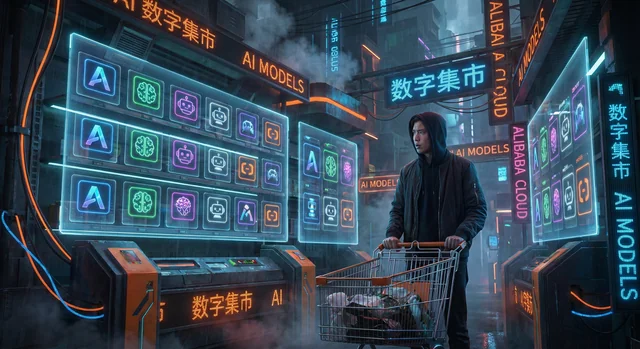
Alibaba Cloud just launched a major update to its Coding Plan subscription service, bundling four of China's top open-source AI models — Qwen3.5, GLM-5, MiniMax M2.5, and Kimi K2.5 — into a single affordable package. The move is being positioned as a game-changer for Chinese developers, but the reality may be more complicated than the marketing suggests.
What's in the Box?
The updated Coding Plan now offers access to 8 coding-focused AI models and over 100 model APIs, along with more than 400 agent templates. The headline additions include:
- Qwen3.5 — Alibaba's own flagship model with 397 billion parameters (17 billion activated via mixture-of-experts)
- GLM-5 — Zhipu AI's latest large language model
- MiniMax M2.5 — Optimized for agentic workflows and multi-step tasks
- Kimi K2.5 — Moonshot AI's reasoning-focused model
The pricing is aggressive: the Lite plan offers 18,000 requests per month for just 7.9 yuan (roughly $1) for the first month, while the Pro plan provides 90,000 monthly requests starting at 39.9 yuan (~$5.50) for the first month.
Compatible With Western Tools — Sort Of
Alibaba claims the Coding Plan works with popular coding assistants including Qwen Code, Claude Code, Cline, and OpenClaw. This cross-compatibility pitch is clearly aimed at developers who want to use familiar interfaces while accessing Chinese AI models. However, the actual integration experience and latency for non-Chinese users remains an open question.
The Skeptic's Take
On paper, bundling multiple top-tier Chinese AI models into one cheap subscription sounds like a no-brainer for developers in China. But several questions linger:
- Pricing sustainability: At less than $1/month for the introductory Lite plan, this looks like a classic land-grab play. These prices almost certainly aren't sustainable long-term, and developers who build workflows around these models may face steep price hikes later.
- Model quality vs. quantity: Having access to 8 models and 100+ APIs sounds impressive, but more options don't automatically mean better outcomes. Most developers will end up using one or two models for the majority of their work.
- The China factor: For developers outside China, regulatory restrictions, data sovereignty concerns, and potential latency issues make this a non-starter for production workloads. This is fundamentally a domestic play.
- Competition is fierce: ByteDance, Baidu, and Tencent are all running similar bundling strategies. Alibaba Cloud isn't innovating here — it's keeping pace.
The Bottom Line
Alibaba Cloud's updated Coding Plan is a shrewd competitive move in China's increasingly crowded AI developer tools market. The pricing is eye-catching and the model lineup is genuinely strong. But cheap subscriptions and model variety alone don't build developer loyalty — reliability, documentation, and ecosystem depth do. Until Alibaba proves it can deliver on those fronts consistently, this looks more like a marketing play than a platform shift.