AI Labor Displacement in 2026 Is Closer Than You Think
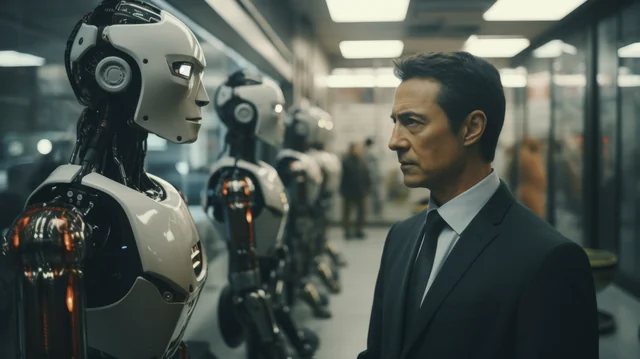
AI Labor Displacement in 2026: What Workers Should Expect
Investors and enterprise leaders are increasingly vocal about a looming shift in how work gets done—and who does it. The concern isn’t abstract. Many believe AI labor displacement will move from theory to reality as early as 2026, reshaping jobs, budgets, and career paths across industries.
This matters because AI is no longer just a productivity add-on. It’s quickly becoming a decision-maker, a task owner, and in some cases, a direct substitute for human labor.
Key Facts: What the Data and Investors Are Saying
The warning signs are already visible. A recent MIT study estimates that nearly 12% of current jobs could already be automated using AI. Employers are reportedly cutting entry-level roles, and some companies have explicitly cited AI adoption as a reason for layoffs.
According to a TechCrunch survey of enterprise-focused venture capitalists, many expect these trends to accelerate in 2026—even though workforce impact wasn’t a direct survey question. Several investors predict that AI budgets will grow while labor budgets shrink, marking a structural change in how companies allocate resources.
Why AI Labor Displacement Matters Now
The bigger story isn’t just job loss—it’s how decision-making is changing inside companies.
For years, AI was sold as a tool to help employees work faster. That framing is shifting. Investors now talk openly about AI agents that can complete tasks end-to-end without human oversight. When software starts owning outcomes instead of assisting with them, workforce math changes quickly.
There’s also a narrative risk. Some leaders argue AI will simply remove “busy work,” freeing employees for higher-value tasks. While that may be true in select roles, it assumes companies will reinvest saved costs back into human talent. History suggests that doesn’t always happen.
In uncertain economic conditions, AI becomes both a solution and a justification. As one investor noted, AI may serve as a convenient explanation for workforce reductions that stem from broader strategic or financial missteps.
The Underlying Trend: From Tools to Autonomous Work
What makes AI job automation in 2026 different from past tech waves is autonomy.
Earlier software required constant human input. New AI systems increasingly operate as agents—handling customer support, data analysis, scheduling, and even decision logic with minimal supervision. This crosses a psychological and operational line.
Once AI can complete work independently, companies begin asking harder questions:
-
Do we need as many people in this role?
-
Can one human oversee multiple AI systems?
-
Is hiring still the fastest path to growth?
These questions are already being asked quietly. By 2026, they may define enterprise strategy.
Practical Implications for Workers and Businesses
The future of work with AI won’t be uniform. Some roles will shrink. Others will evolve. A few will grow rapidly.
For workers, the safest positions will likely be those that:
-
Require complex judgment or accountability
-
Combine technical skills with domain expertise
-
Involve relationship-building, strategy, or oversight
Routine, repeatable tasks—both manual and cognitive—are most at risk.
For businesses, the challenge will be balance. Over-automation can create brittle systems and reputational risk. Under-investment can leave companies uncompetitive. The winners will be organizations that pair AI efficiency with human judgment rather than replacing one entirely with the other.
What Happens Next: 2026 as an Inflection Point
If investor expectations are accurate, 2026 won’t be the end of human work—but it may be the end of business as usual.
Budgets will reveal priorities. If AI spending consistently grows faster than hiring, displacement becomes a structural feature, not a temporary adjustment. At the same time, governments, educators, and workers will be forced to respond faster than they did in previous automation cycles.
The companies that succeed won’t just adopt AI. They’ll redesign roles, retrain teams, and communicate honestly about why changes are happening.
Conclusion: Preparing for AI Labor Displacement
AI labor displacement isn’t a distant threat—it’s a near-term reality that’s already taking shape. While 2026 is shaping up to be a turning point, the real impact will depend on how intentionally organizations and individuals prepare.
Those who treat AI as a cost-cutting shortcut may gain short-term wins but long-term instability. Those who see it as a force that reshapes—not replaces—human contribution will be better positioned for what comes next.
FAQ SECTION
Q: Will AI really replace jobs by 2026?
A: Yes, in some cases. Many investors expect AI to automate entire tasks and roles by 2026, especially repetitive or rules-based work. However, not all jobs will disappear—many will evolve or require human oversight.
Q: Which jobs are most at risk from AI labor displacement?
A: Entry-level, repetitive, and process-driven roles face the highest risk. This includes basic data analysis, administrative tasks, and certain customer support functions where AI agents can operate independently.
Q: Can AI also create new jobs?
A: Yes. AI creates demand for roles in oversight, implementation, ethics, and domain-specific strategy. However, these jobs often require higher skills, meaning reskilling will be essential.
Q: Is AI always the real reason for layoffs?
A: Not always. AI is sometimes used as a justification for layoffs driven by cost pressures or strategic mistakes. The technology can accelerate cuts, but it isn’t always the root cause.