AI Is Widening the Wage Gap Between Knowledge Workers
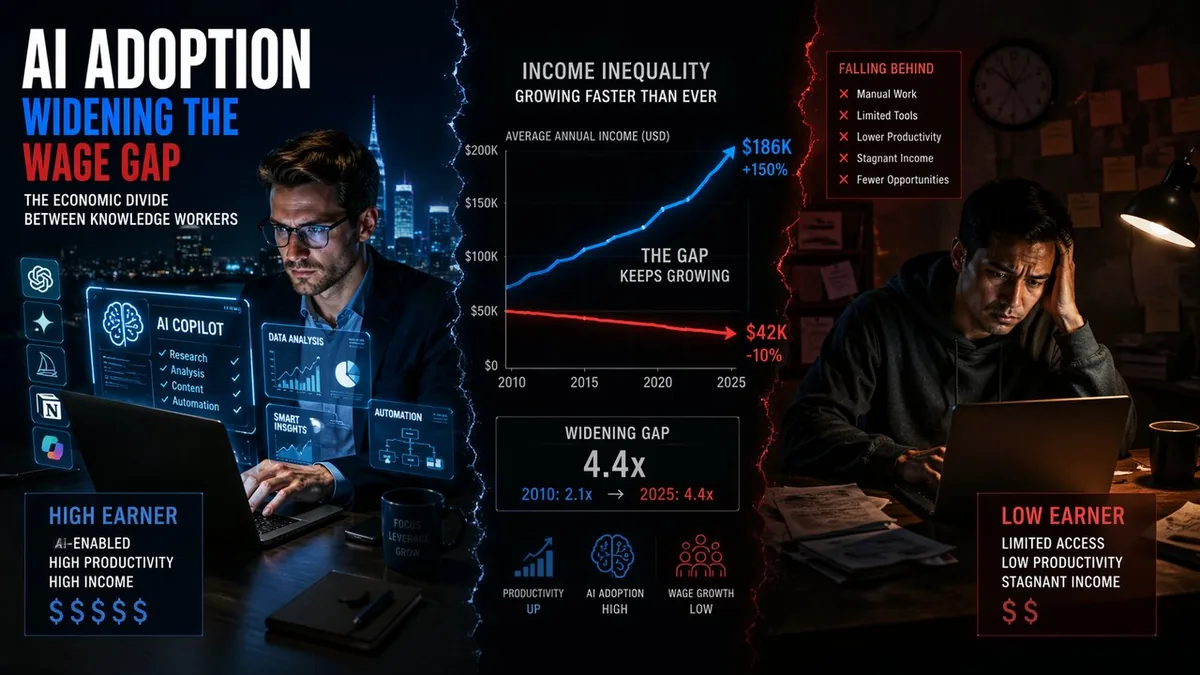
A growing body of research confirms what anecdotal evidence has been suggesting for two years: AI adoption is not equally distributed across the knowledge worker population, and the inequality in access is translating directly into wage inequality. Workers who use AI daily are commanding 15-30% salary premiums over colleagues in identical roles who don't — and the gap is getting wider, not narrower.
The Adoption Divide
Over 60% of top-paid knowledge workers now use AI tools daily. Among lower-earning workers in equivalent job categories, that number is 16%. The gap is not primarily about willingness — it is about access. Senior staff have paid tool subscriptions, dedicated training time, and the autonomy to experiment during work hours. Early-career and frontline workers are largely left to self-teach on personal time or blocked from using AI entirely by corporate IT policies.
The Dallas Federal Reserve's research found that occupations in the 90th percentile of experience premium see a 0.2 percentage point wage growth increase with AI exposure. The more experienced you are, the more AI multiplies your output — and the more that shows up in compensation.
Why the Gap Compounds Over Time
The productivity gains from AI tools are not one-time. A worker who learns to use Claude or Copilot effectively in 2025 builds prompting intuition, workflow integrations, and AI-augmented output quality that accumulates over time. A worker who doesn't access those tools in 2025 falls behind on both the skill and the productivity metric. In competitive labor markets, that gap shows up in performance reviews, promotions, and salary negotiations by 2026.
The experience effect compounds this: senior workers with deep domain expertise use AI most effectively because they can evaluate output quality. Junior workers lack the judgment to catch AI errors, which paradoxically makes AI less useful for them and reduces their productivity gains.
What Organizations Are Doing Wrong
Most organizations that have rolled out AI tools have concentrated access on highest-paid employees — the people with budget authority for subscriptions and the seniority to approve exceptions to IT policy. This is not a deliberate strategy to increase inequality; it is a default outcome of how enterprise software procurement works. Changing it requires intentional deployment decisions that treat AI access as a workforce equity issue, not just a productivity optimization.
My Take
The AI wage gap is a policy failure masquerading as a market outcome. There is nothing inevitable about restricting AI tool access to senior employees — it is a procurement and IT governance choice that organizations are making by default. The companies that give broad AI access earliest will compound their productivity advantage. The ones that don't will create internal inequality that makes talent retention harder, not easier.
Related Articles
- 75% of Google's New Code Is Now AI-Generated: What That Really Tells Us
- OpenAI Launched GPT-5.5 and It Is the Clearest Sign Yet of Where AI Is Heading