AI Drug Discovery: 10xScience Targets Faster, Cheaper Breakthroughs
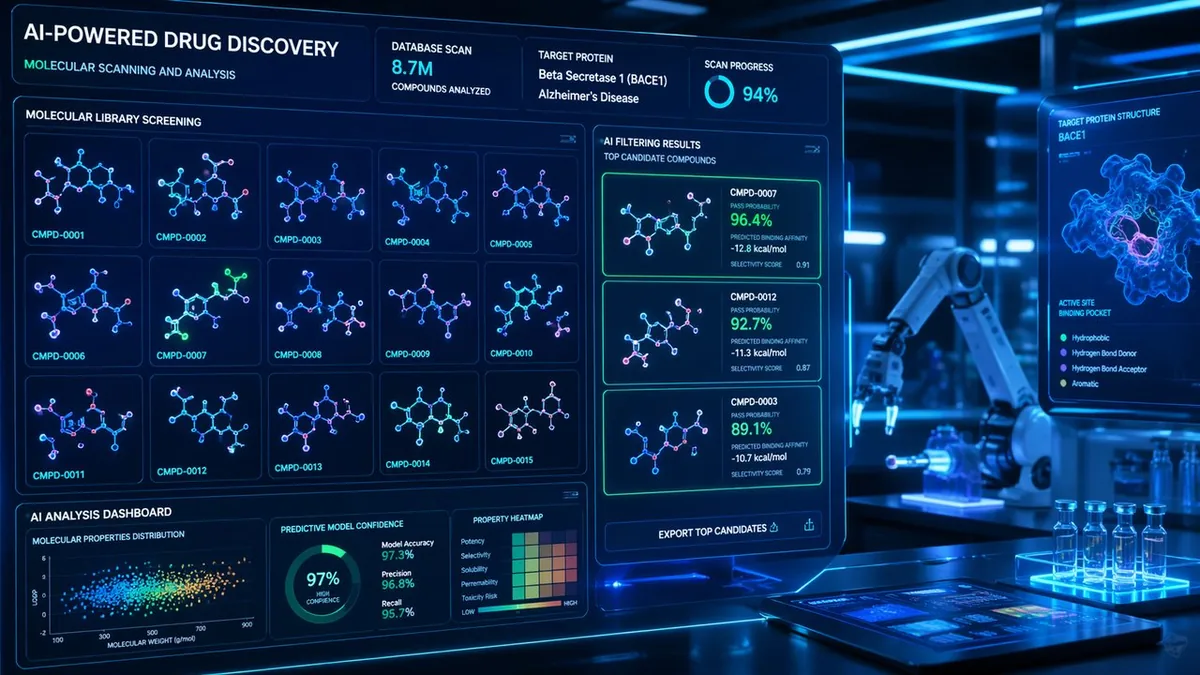
Drug discovery is broken. It costs over $2 billion and takes 10-15 years to bring a single drug to market — and most candidates fail anyway. 10xScience thinks AI can change that math. The company is applying machine learning to the earliest, most expensive stages of pharmaceutical research with a goal that's almost audaciously simple: make drug discovery 10x faster and 10x cheaper.
What's Actually Happening
10xScience is building AI models trained on molecular biology, pharmacology, and clinical trial data to predict which drug candidates are worth pursuing — before you spend billions on development. Their platform targets the preclinical phase: identifying viable compounds, predicting toxicity, and modeling how a molecule will interact with a target protein.
This isn't science fiction. DeepMind's AlphaFold already revolutionized protein structure prediction. Recursion Pharmaceuticals has been applying AI to high-throughput screening for years. 10xScience is positioning itself as the next layer: not just predicting structure, but predicting viability across the full preclinical pipeline.
Why It Matters
The pharmaceutical industry spends roughly $250 billion on R&D annually, globally. If AI can cut even 20% of that waste, the downstream effects are enormous — more drugs reaching patients, lower development costs that don't get passed on as price hikes, and faster responses to emerging diseases. The COVID-19 pandemic showed what accelerated development timelines look like when the political will exists. AI could make that the norm, not the exception.
There's also a competitive angle: whoever cracks AI-driven drug discovery at scale will have leverage over every major pharma company. 10xScience is going after that position. For a broader look at AI investment in this space, see our piece on NeoCognition's $40M seed round for scientific AI reasoning.
My Take
The "10x" framing is classic startup boldness — but in drug discovery, the math actually supports ambition. When baseline timelines are 15 years and failure rates are above 90%, there's enormous room for improvement. You don't need to be perfect to be transformative; you just need to be meaningfully better at picking winners early.
My skepticism is directed at the commercialization path. Pharma companies are notoriously slow to adopt new platforms, protective of their internal research pipelines, and reluctant to share data. 10xScience's success will depend as much on partnership strategy as on the quality of their models. The science might work. Getting entrenched institutions to trust it is the harder problem.
FAQ
What does 10xScience do? They use AI to improve the preclinical drug discovery process — predicting which molecular compounds are viable, reducing the cost and time of early-stage pharmaceutical research.
How does AI speed up drug discovery? By computationally screening millions of compounds and predicting outcomes without requiring physical synthesis and testing of each one — compressing years of lab work into weeks of compute.
Is this related to AlphaFold? Tangentially. AlphaFold predicted protein structures; 10xScience targets the broader pipeline, including how drug candidates interact with those structures and their clinical potential.
Who are their customers? Primarily pharmaceutical and biotech companies looking to reduce R&D costs and improve hit rates in early-stage drug development.
Related Articles
- NeoCognition Raises $40M to Build AI That Thinks Like a Scientist
- Google Cloud Next 2026: AI Agents and Enterprise Tools Take Center Stage