Academy Bans AI-Generated Actors and Screenplays From Oscar Eligibility — 98th Awards Onward
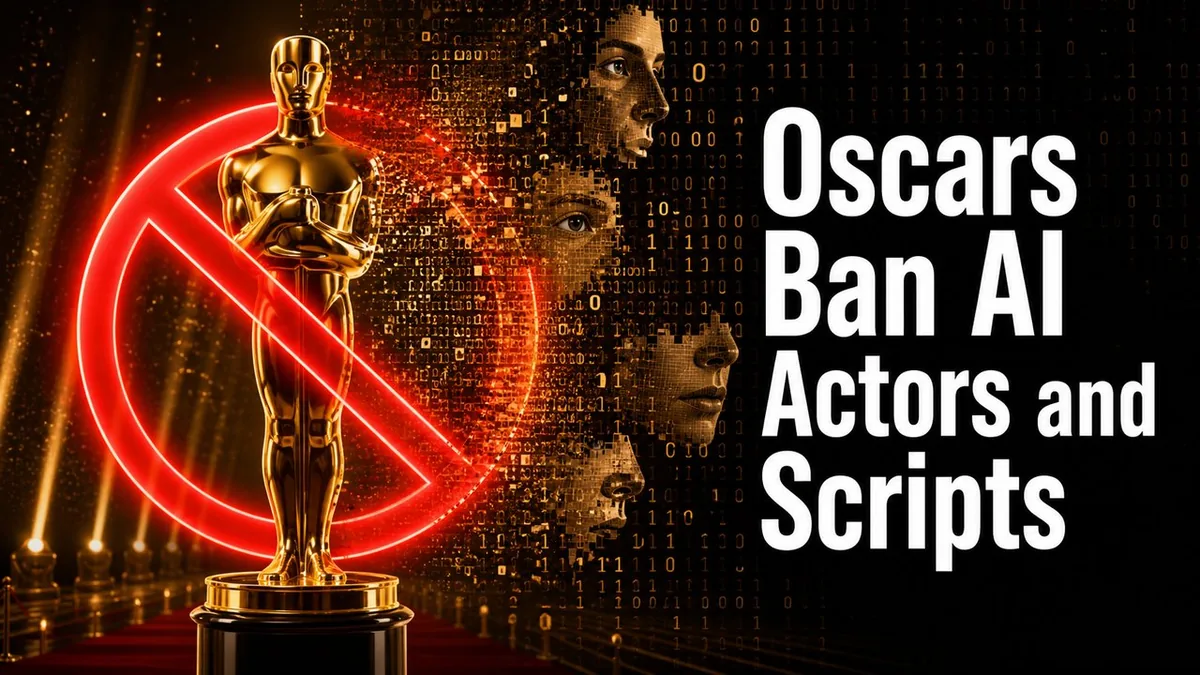
The Academy of Motion Picture Arts and Sciences ruled this week that performances and screenplays generated by artificial intelligence are not eligible for Oscar consideration, formalizing what had been an ad-hoc policy posture into a written eligibility rule. The change — adopted at the Academy's spring board of governors meeting and effective for the 98th Academy Awards (films released in 2026) — is the most consequential anti-AI guardrail any major awards body has put in place to date, and it sets a template the broader industry is likely to follow.
The rule itself is narrower than the headline suggests. AI-augmented performances and AI-assisted screenwriting remain eligible — only fully AI-generated actors and screenplays are banned. The Academy's eligibility committee will require submitting studios to attest, on the official entry form, that the performances and the screenplay credit are credited to identifiable human creators who exercised "primary creative authorship" over the work. The "primary" qualifier is doing a lot of work here, and it's where the political and practical fights will land.
What the rule actually bans, and what it doesn't
The eligibility text covers two distinct categories. First, AI-generated performers — fully synthetic characters, AI-generated digital doubles, and AI-resurrected likenesses (e.g., a deceased actor "performing" via generative AI) — are ineligible for any acting category. Second, AI-generated screenplays — those without human-credited primary authorship — are ineligible for Best Original Screenplay or Best Adapted Screenplay.
What's NOT banned is much broader. AI-augmented visual effects, AI-driven dubbing, AI scene cleanup, AI deaging, AI editing tools, and AI-generated background characters all remain eligible. Performances enhanced by AI but anchored on human acting — facial mocap, voice replacement (with the lead actor's consent and credit), and AI-driven youthing — also remain eligible. The rule explicitly recognizes that AI is a normal post-production tool now and doesn't try to litigate its general use.
Why the Academy moved now
Three pressures forced the timing. First, the SAG-AFTRA / WGA labor agreements that ended the 2023 strikes included strong protections against AI displacement of human performers and writers, but those protections only bind union signatories. The Academy's eligibility rule extends similar guardrails to the awards consideration question, regardless of union status. Second, the 2026 awards season has already seen at least three film submissions where AI-generated supporting characters had meaningful screen time, and the eligibility committee was facing live cases without clear guidance. Third, multiple guilds privately pressured the Academy to set a clearer line before the awards-season campaign cycle started, and the board responded.
The political subtext is also worth flagging. The Academy is increasingly seen as the cultural arbiter for what counts as "real" film versus what counts as something else, and the membership has been under pressure from a younger, more AI-skeptical generation of actors and writers. The rule satisfies that political base while preserving meaningful flexibility for AI as a production tool — a careful threading of the needle.
My Take
This rule is well-designed and probably correct. Awards exist to recognize human creative authorship, not to celebrate the most efficient computational output, and the Academy's distinction between AI-as-tool versus AI-as-creator is the right line to draw. The Grammy Awards adopted similar language on AI-generated music in 2024, and the practical experience there has been smoother than skeptics predicted — AI tools for music production remain widely used, and award-eligible work continues to be human-anchored.
The harder political question is whether this rule will hold against commercial and competitive pressure as AI generative quality improves. By 2028, fully-AI-generated short films of meaningful artistic quality will be commercially viable, and there will be commercial pressure to expand the eligibility line outward. The Academy's rule explicitly contemplates revision in 2027, which suggests they expect the line to move. Today's rule is a holding pattern, not a permanent boundary, and that's the right framing.
For working actors and writers, the eligibility rule is a meaningful win in the broader fight for AI labor protection. It creates a normative anchor — "this work is recognized only if human-authored" — that will influence union negotiations, studio contracts, and audience expectations for years even if the technical rules around it eventually loosen. That cultural anchor matters more than the awards themselves.
What this means for the broader entertainment industry
Three implications for studios, talent agencies, and AI vendors. First, expect more awards bodies to adopt similar rules — the Emmys, BAFTAs, and Cannes Film Festival are the obvious next adopters. Second, expect studio contracts to start including "Academy-eligibility-preserving" clauses for AI-augmented productions, where the studio commits to specific AI usage limits to keep awards eligibility live. Third, expect AI vendors building generative film tools to start marketing "Academy-compliant workflows" as a feature — Runway, Adobe Sensei, and similar tools will likely add audit-trail features specifically to satisfy attestation requirements.
For audience expectations, the long-run effect is a meaningful split: "awards-eligible film" becomes a brand category distinct from "AI-generated content" in a way that's commercially visible. The two categories will likely coexist for the next decade, with awards-eligible work commanding a premium tied to the perceived authenticity of human creative labor.
Frequently Asked Questions
Are AI-augmented performances still allowed?
Yes. The rule only bans performances that are fully AI-generated, including digital doubles and AI-resurrected likenesses. AI used to enhance, deage, or assist a human performance is still eligible.
What about AI-assisted screenwriting?
AI-assisted screenplays — where a human writer is the credited primary author — remain eligible. Only fully AI-generated screenplays without identifiable human authorship are banned.
Does this affect Best Visual Effects?
No. AI-driven visual effects remain fully eligible. The rule explicitly recognizes AI as a normal post-production tool.
When does the rule take effect?
The 98th Academy Awards (films released in 2026, ceremony in early 2027). Submitting studios will need to attest to human primary authorship on the entry form starting now.
The Bottom Line
The Academy's AI eligibility rule is a careful, defensible policy that protects human creative authorship without overreaching into routine AI-augmented production. It sets the template that other awards bodies and the broader entertainment industry will follow, and it gives working actors and writers a meaningful normative anchor in the ongoing AI labor negotiation. Expect this to hold for at least the 98th and 99th awards cycles before any meaningful loosening.
Related Articles
- Spotify Launches Verified Artist Badges
- 35% of New Websites Since ChatGPT Are AI-Generated
- Netflix Launches Clips TikTok-Style Feed