a16z Speedrun Accelerator: How to Stand Out
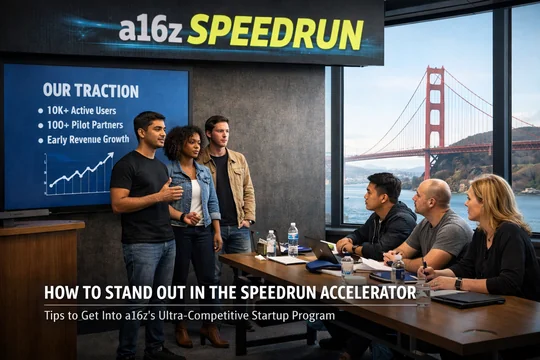
a16z Speedrun Accelerator: How to Stand Out (Without Sounding Like Everyone Else)
Andreessen Horowitz’s Speedrun program has quietly become one of the most competitive startup accelerators in tech—accepting well under 1% of applicants.
That’s not a typo.
If you’re a founder looking at the a16z Speedrun accelerator, the real challenge isn’t “how do I apply?” It’s: how do I look real, sharp, and investable in a sea of polished-but-generic startups?
Let’s break down what Speedrun is actually selecting for—and what you can do to give yourself a serious edge.
Key Facts: What the a16z Speedrun Accelerator Really Is
Speedrun launched in 2023 and runs for about 12 weeks in San Francisco. It now accepts startups across categories (it started in gaming, expanded to entertainment/media, and is now fully “horizontal”).
Here are the key details founders should know:
-
Two cohorts per year
-
50–70 startups per cohort
-
Up to $1M invested per company
-
Typical deal: $500K for 10% via SAFE, plus another $500K if you raise within 18 months
-
Perks include up to $5M in vendor credits (AWS, OpenAI, Nvidia, Deel, etc.)
-
Applications open again in April, but off-season submissions are reviewed year-round
That acceptance rate? According to Speedrun’s own numbers, 19,000+ startups pitched and fewer than 0.4% made it in for the latest cohort.
Why This Matters: The Accelerator Game Is Changing
For years, founders treated accelerators like a startup rite of passage: join, raise, grow, repeat.
But the new reality is different.
The a16z Speedrun accelerator isn’t just funding companies. It’s selecting founder profiles—teams they believe can build through uncertainty, pivot fast, and scale with a16z-level ambition.
And there’s a bigger trend underneath this:
Software is easier to build. Conviction is harder to find.
AI has reduced the barrier to launching a product. Now, the differentiator is no longer “can you ship?” but:
-
Can you reason clearly about the problem?
-
Can you adapt quickly when the market shifts?
-
Can you build a team that doesn’t fall apart under pressure?
Speedrun is essentially saying:
“We’re betting on founders who can survive the chaos.”
What Speedrun Is Actually Selecting For (And What Founders Get Wrong)
Joshua Lu, Speedrun’s general manager, shared several selection signals that matter more than most founders realize.
1) They’re betting on the team, not the pitch deck
Speedrun is early-stage by design, so the program looks hard at the founding team’s strengths, gaps, and chemistry.
They don’t require the classic “technical + business” cofounder pairing. But they do want to see:
-
No major capability holes
-
Self-awareness about weaknesses
-
A believable hiring plan to fill gaps
They also value teams with shared history. It’s not about being best friends—it’s about knowing how to disagree and recover.
2) Traction is a “spark,” not a bonfire
Speedrun isn’t asking for massive revenue.
But they do want proof that you’ve built something and tested it with the real world.
Lu described it as looking for a small spark they can pour gasoline on.
That’s a subtle but powerful insight:
Speedrun isn’t trying to help you find product-market fit from scratch.
They want to accelerate momentum that already exists.
3) Too much “market theory” is a red flag
One of the biggest application mistakes founders make is spending too much time explaining why the market is huge and the problem is real.
That might be true, but it’s also what everyone says.
Speedrun wants a different answer:
Why is YOUR team the best possible team to solve this?
This is where many founders fail, because it requires specificity, not hype.
Practical Predictions: What Winning Speedrun Applications Will Look Like in 2026
If you want a real advantage, stop optimizing for “startup language.”
The strongest Speedrun applications going forward will likely have these traits:
They read like strategy memos, not marketing copy
Founder Mohamed Mohamed (Smart Bricks) said he treated the application like an internal strategy memo, focusing on clarity and honesty.
One of his best quotes is also one of the best founder lessons:
“Depth beats polish every time.”
That’s not just advice for Speedrun—it’s advice for every serious investor conversation.
They show intellectual honesty
Founders who admit what isn’t working come across as more credible, not less.
Speedrun is evaluating how you think. If you pretend everything is perfect, it signals you’re either inexperienced—or not paying attention.
They use AI, but don’t outsource their thinking
Lu openly encourages founders to use AI to clean up writing and improve clarity.
But he also warns: if AI writes your application for you, you’ll get exposed in the live interview stage.
Only about 10% of founders make it to video calls. At that point, your ability to explain your startup—without ChatGPT holding your hand—is the test.
How to Get Into Speedrun: A Practical Checklist
If you want a clean, founder-friendly action plan, use this before applying:
-
Write the “why us” section first (not the product description)
-
Show a real spark: users, pilots, LOIs, waitlist, retention, anything
-
Explain the hard part of the business clearly
-
Be honest about risks and unknowns
-
Make your team story specific (not generic resumes)
-
Use AI to edit—not to invent your narrative
-
List who you want access to at a16z and why (operators, GTM, recruiting, etc.)
That last one matters more than people think. Speedrun loves founders who are, in Lu’s words, “greedy to network.”
Conclusion: The Real Secret to the a16z Speedrun Accelerator
The a16z Speedrun accelerator isn’t looking for perfect startups.
It’s looking for founders who can build through ambiguity, communicate clearly, and show real proof they’ve started solving a hard problem.
The founders who win aren’t the ones with the slickest branding.
They’re the ones who can say, confidently and honestly:
“Here’s what we know, here’s what we don’t, and here’s why we’re still the right team to solve it.”
And in a world where anyone can generate a pitch deck in 10 minutes, that kind of clarity is the rarest signal of all.
| Feature | Speedrun (a16z) | Y Combinator |
|---|---|---|
| Cohort focus | Horizontal (any category) | Broad (any category) |
| Duration | ~12 weeks | ~3 months |
| Location | San Francisco | Hybrid (often SF-based) |
| Investment structure | Up to $1M, often $500K for 10% | $125K for 7% + $375K SAFE |
| Strength | Deep operator network + brand | Massive alumni + fundraising gravity |
| Best for | Teams wanting hands-on expert support | Teams wanting broad startup network |
Bottom Line: If you want operator-heavy help and access to specialized experts, Speedrun is compelling. If you want the biggest founder network and predictable fundraising pipeline, YC is still the standard.
FAQ SECTION
Q: How hard is it to get into the a16z Speedrun accelerator?
A: It’s extremely competitive. Speedrun has reported acceptance rates under 1%, with fewer than 0.4% accepted in one recent cohort. You need a strong team, early validation, and a clear explanation of why you’re uniquely positioned to win.
Q: What does Speedrun look for in founders?
A: Speedrun prioritizes founder strength, team chemistry, and self-awareness. They want teams with complementary skills, credible hiring plans, and the ability to reason clearly through complex problems—not just a polished pitch.
Q: Can I use AI to write my Speedrun application?
A: Yes, but carefully. Speedrun encourages founders to use AI for clarity and editing. But if your application sounds AI-generated or you can’t explain your startup clearly in a live interview, it can hurt you.
Q: Is Speedrun better than Y Combinator?
A: It depends on what you need. Speedrun offers deep access to a16z’s operator network and resources. YC offers a huge alumni base and a proven fundraising ecosystem. The best choice depends on your startup stage and support needs.
Q: When do Speedrun applications open?
A: Speedrun runs two cohorts per year. Applications for the next cohort typically open in April, and the program also reviews off-season applications year-round.