A New Era for Navigating the Road
A New Era for Navigating the Road
If you thought your navigation app was good enough, the newest upgrade to Google Maps takes it a step further. According to recent coverage, Google is injecting its Gemini AI into Maps so that the app behaves less like a cold tool and more like an attentive co-pilot. AP News+2The Verge+2
But beyond the tech headline, the real question is: What does this mean for you—especially in regions like India where road conditions, traffic and driving habits differ from the U.S.?
What’s Changing: The Key Features of the Upgrade
Here’s a breakdown of the major enhancements coming to Google Maps with Gemini (based on reporting from sources). Talk Android+3The Verge+3AP News+3
Hands-free, Conversational Navigation
You’ll now be able to speak naturally while navigating: ask for a vegan-friendly restaurant along your route, check EV chargers, share ETA, or even have the app add a calendar event on your behalf—all without ever touching the screen. The Verge+1
This means less distraction and a smoother focus on driving.
Landmark-based Guidance
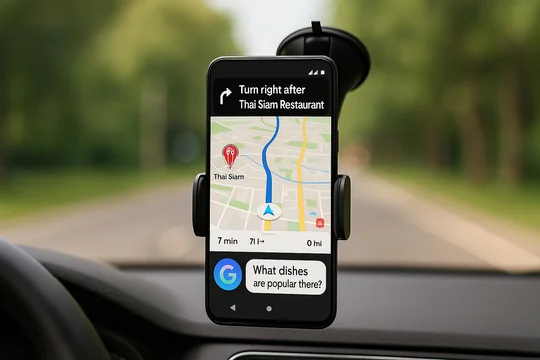
Instead of “turn in 500 feet,” the app will say “turn right after the Thai Siam Restaurant” or “just past the petrol pump on the left” — leveraging a database of ~250 million places and Street View imagery to make directions more intuitive. AP News+1
For crowded or unfamiliar roads (as many in India are), this could be a game-changer.
Proactive Traffic Alerts
Even when you’re not actively navigating, the app can monitor your regular routes and alert you about upcoming accidents, closures or slowdowns—giving you time to reroute before you’re stuck. The Verge+1
That’s especially useful in cities where traffic jams are unpredictable.
Visual Place Insights via Camera
Once you reach a destination, you can use the camera in the search bar to identify places around you (restaurants, shops, landmarks) and ask contextual questions: “What dishes are popular here?” or “What’s the vibe inside?” This feature uses Gemini + Maps’ understanding of places. AP News+1
Why This Matters — Especially for Indian Drivers
1. Reduced Distraction, Better Focus
Driving while fiddling with the screen still causes many mishaps. With true voice-interaction and natural language commands, this upgrade aims to reduce the need for glancing at your phone or typing mid-drive.
In India’s dynamic traffic environment, that’s a meaningful safety improvement.
2. Landmark-based instructions are more intuitive than distance metrics
In many Indian cities, meters or feet don’t always help — landmark cues (a temple, shop, toll plaza) are much easier to follow. Maps’ shift to using real-world visible cues should make it easier for drivers to find turns and avoid confusion.
3. Enhanced route planning & stops
Say you’re driving from Agra to Jaipur and want a lunch stop with good local food and parking space: you could ask something like “Find a vegetarian-friendly dhaba with parking on my way.” Gemini in Maps makes this plausible.
This kind of dynamic stop planning blends direction + experiential choices, which is great for longer trips.
4. Handling unforeseen traffic issues
Indian roads aren’t always predictable. The proactive alert system means you’ll get informed about a flood-affected road, an accident or heavy congestion on your regular route—potentially saving you time and stress.
5. Future readiness for EVs and connected cars
The article mentions EV charger availability along your route. As India moves towards electric mobility, having this built-in will help. The Verge
Our Take: What to Watch Out For
Will it roll out in India promptly?
While the features are being introduced in the U.S. first, global rollout timings vary. Indian users should keep their apps updated and watch for regional availability.
Data quality & local relevance matter
AI is only as good as its data. In less mapped areas, landmark cues, charger databases or accurate voice responses may lag. Google claims “grounding” in its large dataset to avoid hallucinations. The Verge
But India’s unique roads and conditions pose a stronger test.
Privacy & permissions
Voice interaction, calendar integration and camera-based place queries mean more access to your data. Be sure to review permissions, especially when using stops, EV information or location-based suggestions.
Dependence vs backup
Even the smartest AI may misinterpret a voice command or miss a local nuance (roadworks, temporary diversions). It’s still wise to glance at the map and remain aware. Think of Gemini in Maps as your helper not a full replacement for your alertness.
Conclusion: A Smarter Co-Pilot for the Road
The integration of Gemini into Google Maps signals a shift from passive navigation to interactive, conversational journey-management. For Indian drivers used to surprises, dense roads and the need for quick pivots, this upgrade could significantly improve the driving experience — if the rollout is timely and the local data robust.
As technology catches up with real-world driving, the app isn’t just plotting routes—it’s helping you experience the journey with less friction and smarter assistance.